
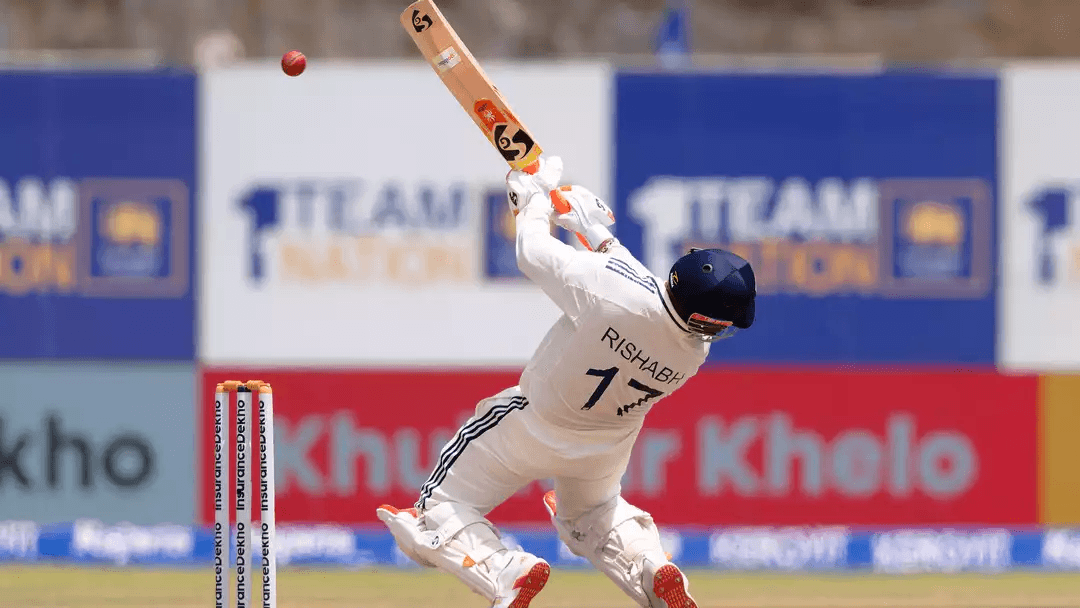
There is a familiar feeling whenever Rishabh Pant walks out to bat.
You never quite know what is coming next.
It could be a quiet defensive stroke. It could be an outrageous reverse sweep. Or, without much warning, a ball could disappear into the stands.
But what made Pant’s latest innings in Galle particularly interesting was not just the sixes or the boundaries.
It was the patience behind them.
On a day when Sri Lanka tried almost everything to stop him from taking the game away, Pant initially refused to play along. He watched the short balls, left deliveries outside his hitting zone and waited for the moments when the bowlers gave him something he could attack.
Eventually, he did what Rishabh Pant does best.
He changed the game.
Rishabh Pant Reaches 100 Test Sixes
Pant’s innings had a major milestone attached to it.
During India’s second innings in Galle, he hit his 100th six in Test cricket, joining an exclusive group of powerful Test batsmen.
The achievement puts him alongside some of the most aggressive hitters the format has produced.
Adam Gilchrist also finished with 100 Test sixes, while Brendon McCullum reached 107. Ben Stokes remains ahead with 137.
But there is another number that makes Pant’s achievement even more impressive.
He needed only 4,918 deliveries to reach 100 Test sixes.
Gilchrist took 6,578 balls, Stokes 9,042 and McCullum 9,756.
That tells you something about Pant’s approach to Test batting. He doesn’t merely score quickly when the situation allows it. Aggression is naturally built into his game.
Sri Lanka Tried to Play Pant at His Own Game
After lunch, Sri Lanka clearly decided that they could not allow Pant to dictate the tempo.
Asitha Fernando came around the wicket and used a short-ball plan with several fielders positioned on the boundary.
On paper, it was a sensible strategy.
Pant has often been willing to take risks against short bowling. Give him enough temptation and there is always a chance that he will try something spectacular.
But this time, Pant showed a different side of his batting.
He simply moved away from the rising deliveries.
There was no unnecessary shot.
No desperate pull.
No attempt to prove that he could hit everything.
For a player whose reputation is built around fearless cricket, that restraint was perhaps the most impressive part of the innings.
The Battle With Sri Lanka’s Spinners
The contest became even more interesting when Sri Lanka turned towards spin.
Keshara Nuwantha kept attacking Pant from around the wicket and tried to create uncertainty outside off stump.
Pant didn’t rush.
He repeatedly reached the ball and chose to leave it when the shot wasn’t there.
The spinner occasionally managed to catch him between decisions, but Pant gradually started finding ways to take control again.
When the length came closer to his preferred hitting zone, the response was immediate.
A sweep.
A reverse sweep.
Then another attacking shot.
Suddenly, the pressure was moving in the opposite direction.
Then Pant Switched Gears
This is where the innings began to look more familiar.
Sri Lanka had spent a long period trying to contain him. Pant had absorbed the pressure, resisted the temptation to attack everything and waited for the bowlers to make mistakes.
Once he felt comfortable, the tempo changed.
Lahiru Kumara became one of the main targets.
Pant moved across his crease and pulled the fast bowler over fine leg to bring up his half-century.
The shot also took him to the milestone of 100 Test sixes.
And perhaps the most revealing moment came immediately afterwards.
Another short delivery arrived.
This time Pant simply got out of the way.
That sequence summed up his innings perfectly.
He was aggressive when he wanted to be, but he wasn’t aggressive just for the sake of it.
Pant’s 66 Was More Important Than It Looked
Pant eventually fell for 66 from 69 balls, attempting to attack another short delivery.
The top edge went through to the wicketkeeper, ending an innings that had frustrated Sri Lanka for a considerable period.
On the surface, 66 might not look like a massive score.
But the circumstances made it extremely valuable.
India already had a substantial lead, and Pant’s attacking contribution pushed that advantage even further. By the time the innings ended, India had moved to a lead of 371 runs.
Pant had changed the momentum without needing to bat for hours.
That is one of his biggest strengths as a Test player.
A Knock That Mixed Patience With Chaos
The interesting thing about this innings was that it wasn’t pure Pant-style chaos.
There was calculation involved.
Against the pacers, he was selective. He scored 17 runs from 21 deliveries in the medium-hard length area before eventually falling to the 22nd ball.
Against the harder-length deliveries, he found ways to score quickly.
And when Sri Lanka finally offered a genuine scoring opportunity, Pant attacked it without hesitation.
That balance is what made the innings so effective.
It wasn’t simply about hitting sixes.
It was about knowing when not to hit them.
India Needed Exactly This Kind of Impact
India’s innings ended relatively quickly after Pant’s dismissal, but by then the damage had already been done.
His partnership with Ravindra Jadeja was worth 54 runs, although Jadeja contributed only seven of them. For long periods, Jadeja’s main job was simply to watch Pant create the entertainment at the other end.
That tells you how much control Pant had over the passage of play.
Sri Lanka had bowled well enough to take wickets and keep India from running away completely.
Yet Pant still found a way to make their plans look ineffective for an important stretch of the innings.
Why This Rishabh Pant Innings Matters
Pant has always been associated with risk.
That is both his greatest strength and, at times, his biggest weakness.
But in Galle, he showed that he can manage that risk rather than simply embrace it.
He didn’t attack every short ball.
He didn’t chase every delivery outside off stump.
He waited.
Then, when the opportunity appeared, he went after it.
That is an encouraging sign for India because Test cricket isn’t only about playing aggressively. It is about understanding when aggression can change the game.
Pant clearly understood that on this occasion.
Rishabh Pant Continues to Redefine Test Batting
The 100-six milestone adds another chapter to Pant’s unusual Test career.
He has already shown that a wicketkeeper-batter doesn’t have to play the traditional supporting role. He can be a match-winner, a momentum changer and sometimes the player who completely alters the direction of a Test session.
The fact that he reached 100 sixes faster than the other major six-hitters makes the achievement even more striking.
There may still be plenty of time left in Pant’s Test career.
If he continues to combine his natural attacking instincts with the kind of restraint he showed in Galle, he could end up setting a six-hitting benchmark that is extremely difficult for the next generation to match.
The Bigger Picture for India
India eventually walked away from the day’s play with a 371-run lead, while Sri Lanka could at least take some satisfaction from taking 14 wickets during the day.
But Pant’s innings was the defining individual performance.
He came in with Sri Lanka trying to control the game.
He left after turning the pressure back on them.
And somewhere in between, he reached 100 Test sixes.
That is probably the best way to describe Rishabh Pant.
Even when he appears to be playing within himself, there is always the possibility that the next few deliveries will belong entirely to him.
In Galle, they did.
And this time, the most impressive part wasn’t simply how hard Pant hit.